We have been here before, you and I. Not in Milan, necessarily, though Milan is a perfectly fine place to be proven right. We have been here in the argument — the patient, recurring, occasionally thankless argument that ties matter, that tailoring endures, that prep is a tradition with a history rather than a mood with a hashtag, that the things worth wearing are the things that mean something.
We have made this argument about cufflinks. We have made it about Tokyo, about the natural shoulder blazer, about the correct way to knot a tie, about the distinction between the rowing blazer earned and the rowing blazer borrowed. We have made it, most recently, about a gentleman on Instagram who called himself a standard-bearer of something called The New Prep while wearing a Breton stripe and a bandana and no visible connection to anything that might be called prep.
On Friday evening in Milan, Ralph Lauren settled the argument. He did it with a speedboat.
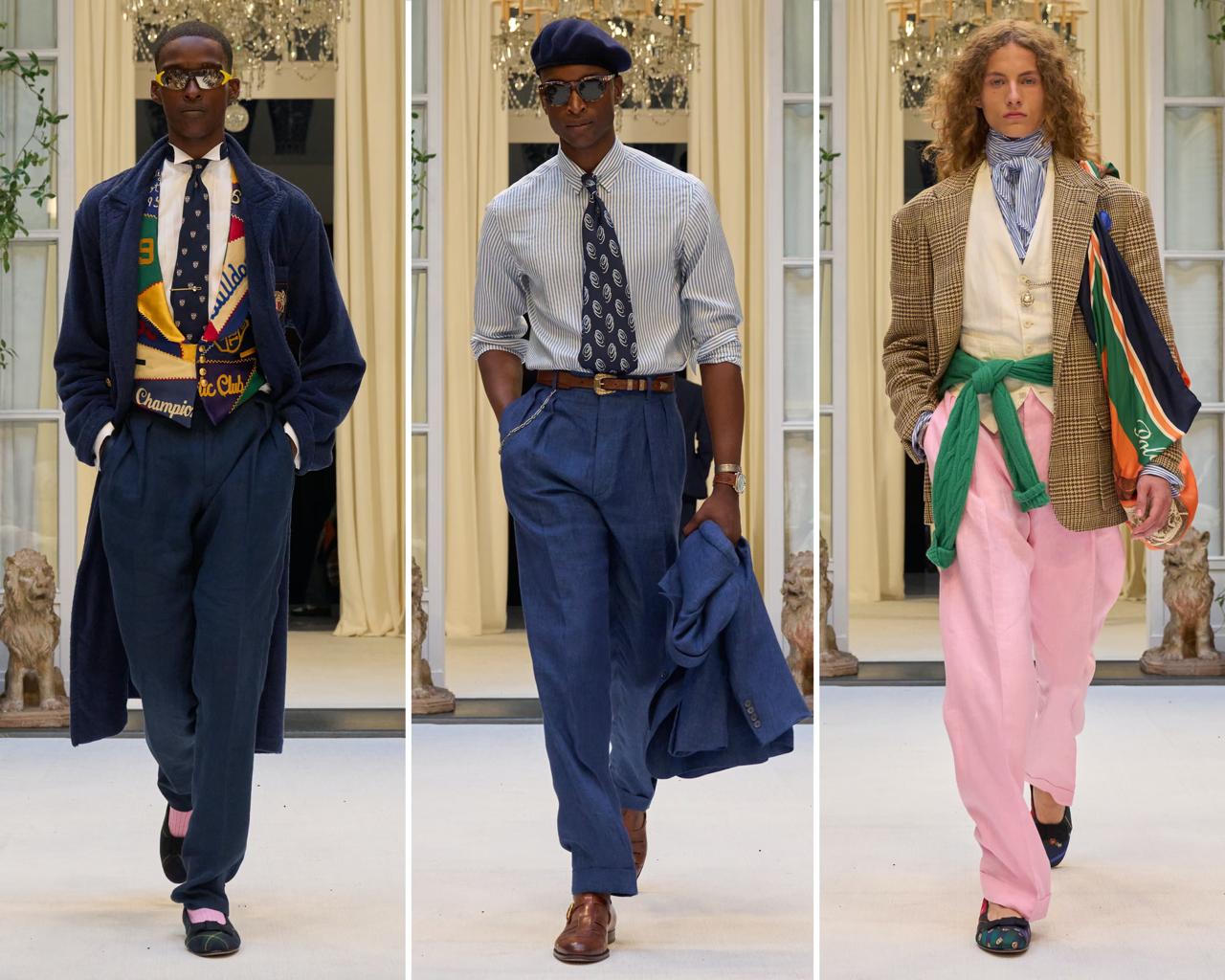
The Return
This was Ralph Lauren's second standalone menswear show in Milan, and the first in which he placed the tie — the specific tie, the original tie, the tie he used to launch his empire in 1967 from a single drawer in the Empire State Building — at the centre of the collection.
Silk ties with subtle swirling prints, knotted over elegant pinstripe suits. Brightly striped cravats worn peeking out from under knitwear and rugby shirts. Ties used in place of belts. Ties wrapped around bags. The uppers of espadrille shoes formed from ties spliced together.
Not a tie as afterthought. A tie as thesis statement. A tie as the thing this whole enterprise has always been about, returned to its rightful position at the centre of the frame after decades of being treated as optional, eccentric, or worse — irrelevant.
"I started with a tie. But it was never just about a tie. It was a way of living." — Ralph Lauren
We know. We have been saying this for some time. It is gratifying, as ever, to have the point confirmed by someone who started the whole thing.
The Speedboat
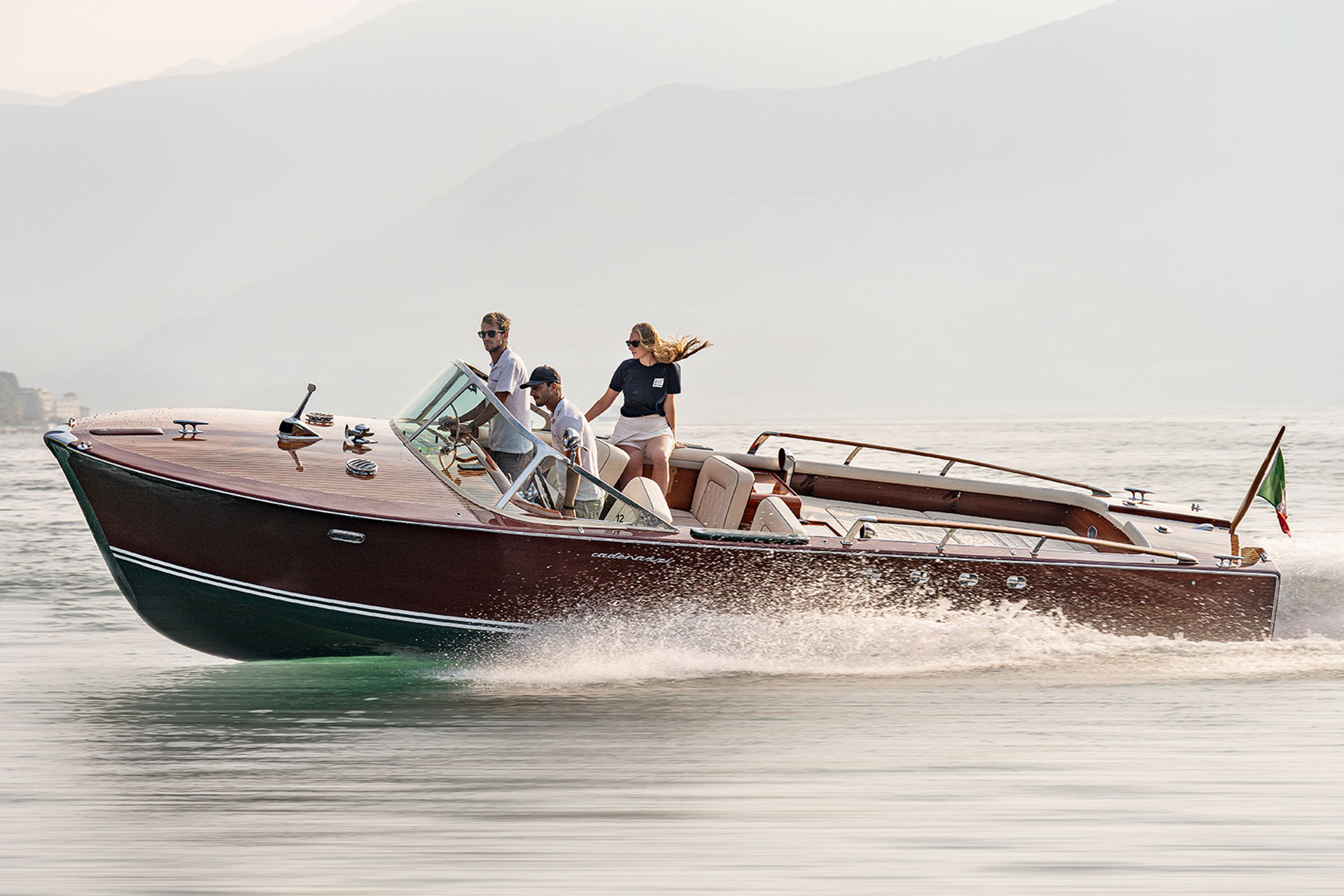
The setting was Palazzo Ralph Lauren, Lauren's Milan headquarters — a sprawling palazzo he acquired in 1999, which is itself a statement about the relationship between patience and real estate. In the courtyard sat a gleaming 1920s mahogany speedboat. Guests arrived to find themselves transported — not to the Hamptons, not to the Upper East Side, not to the usual Ralph Lauren geography — but to the golden age of Italian sport. Lake Como in the 1920s. Zipping across the water in something beautiful before anyone had invented the word lifestyle.
This is what Ralph Lauren does that nobody else does. He doesn't design clothes. He builds worlds, and the clothes are the passport. The speedboat wasn't a prop. It was a declaration: this is where these clothes belong, this is who wears them, this is the life they make possible. Textured knitwear in sea-salt whites. Nautical blues. Reversible butter-soft leather jackets lined with cashmere. Reflective racer sunglasses, deck shoes, squashy tote bags stowable onboard.
The fantasy was specific. Specific fantasies are always more powerful than vague ones. Anyone can dream of being rich. Fewer people can dream of zipping across Lake Como in a 1920s Riva in a cashmere-lined leather jacket with a silk tie knotted just so. But the ones who can dream it will dress for it. They always have.
The Bridge
The show combined Purple Label — the dapper-driven, hand-tailored upper register — with Polo, described by Lauren in his notes as "the next-generation vision of American prep." This is the trick that nobody else in fashion is currently managing: serving octogenarians and Gen Z simultaneously, without condescending to either.
Polo came with camo trousers worn loose, colourful checked shirts untucked, rugby shirts patchworked with flowers and crossbones, neat blazers clashing with paint-speckled denim. The secondhand-platform generation can riff on all of it. They have been discovering Ralph Lauren the way every generation discovers him — as if for the first time, as if he invented it just for them. He did, in a sense. He invents it for everyone. That is the trick.
Gen Z has recently discovered both the brand and the tie. The tie, in particular, they approach with the enthusiasm of people who have found something their parents and grandparents inexplicably abandoned. They are not wrong. Their grandparents were. The tie did not go away. It simply waited, with the patience of all genuinely good things, for the moment when the people who had dismissed it would be outnumbered by the people discovering it.
Our piece on ties argued exactly this. We are not surprised. We are, however, quietly pleased.
The Numbers
$8bn
Ralph Lauren revenue, last fiscal year — record high · +15% growth
While the rest of the luxury sector has spent the past eighteen months grappling with a slowdown — revenues contracting, houses pivoting, the usual anxious adjustments to the usual anxious forecasts — Ralph Lauren has been breaking records. Sales for the last fiscal year increased by 15%. Revenue exceeded $8 billion for the first time in the company's history.
The man who started with a tie in a drawer in the Empire State Building now runs a multi-billion dollar empire, and he did it by being consistently, stubbornly, unfashionably himself. By refusing to chase the moment. By building the world and letting the world come to him.
There is a lesson here that the fashion industry is constitutionally reluctant to learn, which is why it keeps having to be taught. The lesson is: the things that last are the things that mean something. The tie means something. The natural shoulder blazer means something. The rep stripe means something. The prep tradition, properly understood and properly worn, means something.
The things that merely trend mean nothing, and nothing is exactly how long they last.
The Vindication
This column has spent the past year making a series of connected arguments. That cufflinks are not dead, they are simply waiting for the man with the wrist to wear them. That Tokyo understood the Ivy League better than the Ivy League understood itself. That the return of tailoring was not a trend but a correction. That prep is a tradition with a specific geography and a specific wardrobe and a specific attitude, and that none of these things are a Breton stripe and a bandana. That the signal, to mean anything, must be earned.
Ralph Lauren walked into a palazzo in Milan with a 1920s speedboat and sixty years of conviction and proved all of it in seventy-three looks.
"We would say we told you so. We already did. Several times, in this column, with footnotes."
The Arguments, in Order
Cufflinks? Seriously? — March 2026 Tokyo Calling — April 2026 In Praise of Ties That Know Their Place — February 2026 The Impostor in the Polo Shirt — June 2026 Ivy 2025: How Menswear Stole Back Its Soul — August 2025Nicholas Whittle
Contributing editor. Based in Central Java.
Writes on menswear, watches, and the correct way to make a Martini.