There is a gentleman on Instagram — and for the purposes of this argument he stands in for a considerable movement — who portrays himself a standard-bearer of something called The New Prep. He is photographed on the streets of New York in a quilted olive jacket over a plaid shirt, an orange bandana knotted at the throat, a patterned flat cap, long dark hair. The caption reads "PEAS & CARROTS." The hashtag reads #TheNewPrep.
What he's doing has its own coherence and its own intelligence. The layering is considered. The colour relationships show a real eye. A second image doubles down: Breton stripe, wide-leg jeans, white sailor cap, the red bandana making a return appearance. Overlaid in bold: THE NEW PREP.
If you called it downtown New York workwear with a nautical accent and a vintage sensibility, you would be paying it an honest compliment. The street style tradition it draws from is legitimate, and the eye behind it is genuine. 507 likes, and deservedly so.
The problem is not the clothes.
The problem is the hashtag.
What Prep Actually Is
In August of last year, this column wrote about the intelligent insurrection at the intersection of Ivy League heritage and contemporary menswear — Beams Plus, Aimé Leon Dore, the Japanese rediscovery of American trad that turned out to be more rigorous than the original. The argument was about seizing the establishment's own weapons and turning them against everything they represent.
That argument assumed the people doing the seizing knew what the weapons were.
Prep is a specific tradition with a specific geography, a specific wardrobe, and a specific attitude. It emerged from the north-eastern American university system. It was transplanted to Japan in the 1960s, where a group of photographers documented Ivy League students in Take Ivy — a book so meticulously observed it sold for extraordinary sums when it finally reappeared after decades out of print. The Japanese, characteristically, understood it better than its originators. Beams, Ships, United Arrows have been the most faithful custodians ever since.
Ralph Lauren did not invent prep. He mythologised it — turned a wardrobe into a world, a set of clothes into an aspirational universe. Not a small achievement. But it rested on a foundation that existed before he arrived.
That foundation has specific components. The Oxford button-down — collar points fastened because polo players needed them not to flap. The natural-shoulder blazer — the shoulder falling where the man's shoulder falls. The chino, the loafer, the rep tie, the Shetland sweater, the cricket sweater worn with the same authority as a t-shirt. These are not random items. They are a system, each piece earning its place through utility, longevity, and indifference to fashion cycles.
Prep is not about looking rich. It is about looking as though the question has never occurred to you — an incredibly sophisticated position to occupy. The worn-in quality is not manufactured distress. It is actual wear. The Nantucket red that faded to pink over a decade of summers. The boat shoe that has been on a boat.
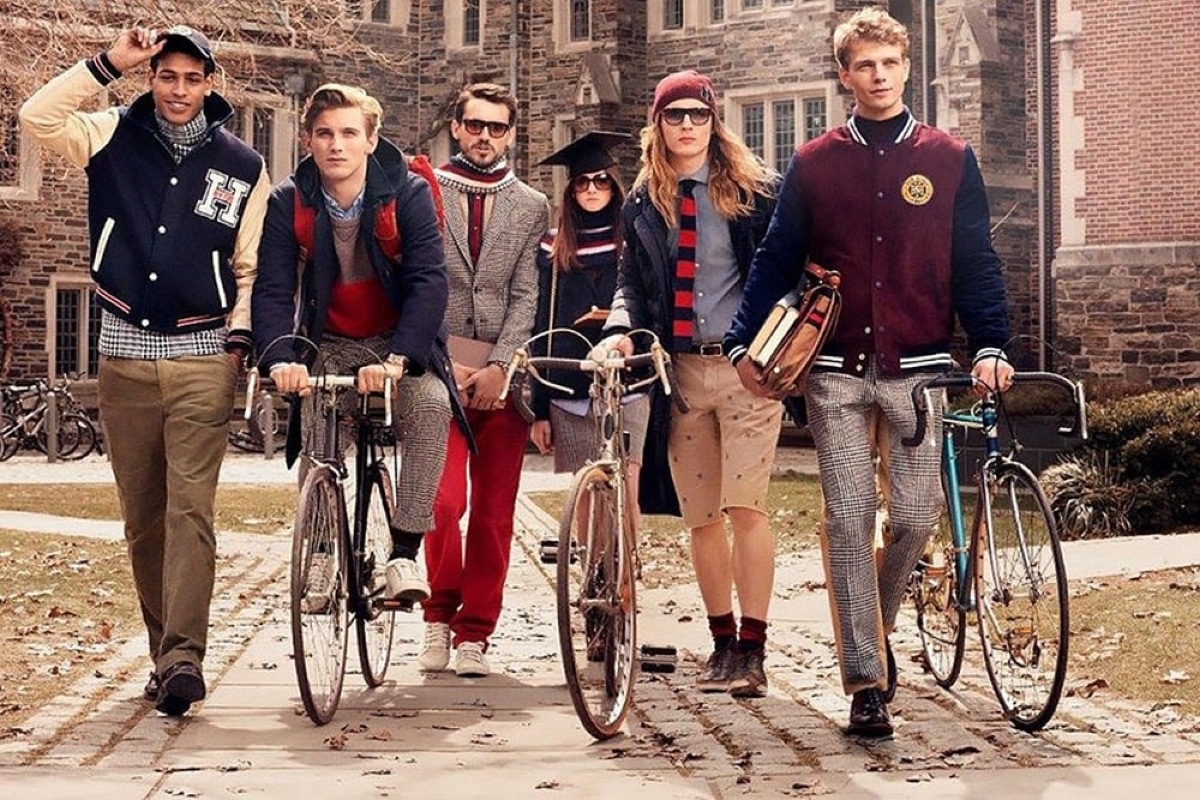
What Is "The New Prep" Actually
Search #TheNewPrep and you will find: Breton stripes, baker boy caps, wide-leg jeans, bandanas, olive and khaki, vintage workwear. A perfectly coherent downtown New York street style aesthetic with a nautical accent and a vintage sensibility.
It has nothing to do with prep.
The Breton stripe is French fisherman. The baker boy cap is Edwardian working class. The bandana is American workwear and counterculture. All legitimate traditions — and worn with the intelligence our man on Instagram clearly possesses, they produce something worth looking at. They simply belong to a different story.
What has happened is that "preppy" has become an Instagram mood tag — a shorthand for studied casualness and vintage sensibility, heritage without the inconvenience of understanding whose heritage or what it means. This year's forecasters have declared prep the defining menswear movement of 2026. Search interest up 200%. One publication describes it as being about "ease, individuality, and reinterpretation" — the language used when someone wants the cultural authority of a tradition they haven't bothered to read.
"The quarter-zip is not prep. It is ski lodge circa 1987, corporate casual circa 1997, tech-bro uniform circa 2017. Its rehabilitation is welcome. Its conscription into the prep tradition is a misdemeanour."
The quarter-zip, for the record, is not prep. It is ski lodge circa 1987, corporate casual circa 1997, tech-bro uniform circa 2017. Its rehabilitation is welcome. Its conscription into the prep tradition is a misdemeanour.
Why It Matters
Traditions evolve. The best ones evolve because the people evolving them understand what they're working with. The Japanese trad scene produced something more rigorous than the original because its practitioners studied the source material with scholarly devotion. Aimé Leon Dore produces something genuinely new because Teddy Santis knows exactly which rules he's breaking and which he's keeping.
The difference between evolution and erasure is understanding.
The street style tradition and the prep tradition are not enemies. They are different languages. A man fluent in both can move between them with the ease of a natural bilingual. What he cannot do is call one by the name of the other and expect the confusion to be harmless.
It isn't harmless. It evacuates the word of meaning, and meaning is precisely what makes the tradition worth inheriting.
The Actual Insurrection
Last year's insurrection was real. It was good, and it remains so.
What it requires, as all insurrections do, is knowing what you're rebelling against and what you're fighting for — the James Dean approach doesn't cut it. Seizing the establishment's weapons without understanding what they were forged for produces not revolution but pantomime.
The New Prep, as currently constituted on Instagram, is pantomime. Enthusiastic, well-photographed, occasionally charming — and in the case of its better practitioners, genuinely stylish. But the real thing is out there, quietly waiting. In the Beams Plus archive. In a Take Ivy reprint. In the roll of a collar on a shirt worn enough to merit its own footnotes.

It is not in a hurry. It has been here since before the hashtag existed. It will be here long after the algorithm moves on.
Nicholas Whittle
Contributing editor. Based in Central Java.
Writes on menswear, watches, and the correct way to make a Martini.