Having just spent a month home in England, I have decided to indulge myself. As sure as Augusta's azaleas herald the summer sporting season in the US, May and early June in England mark the climaxes of the muddier winter sports. A return to the flat on the racecourses, the pristine lawns of SW17, and the Test match at Lord's. Along with the Champagne, strawberries and cream, copious Pimm's, and packed grandstands, you can also witness several thousand well-dressed men simultaneously and with great conviction, shed the subfusc of Barbour and Wellingtons to unveil their gaudier summer plumage.
The English summer season — Ascot, Wimbledon, Henley, Glorious Goodwood, the Test match series (cricket, if you are wondering) — represents one of the last sanctioned occasions in Western culture where a man may dress with genuine ceremony and not be considered eccentric for doing so. This is a privilege. It deserves better than what it typically gets.
What it typically gets is the novelty waistcoat.
On Legitimate Signals
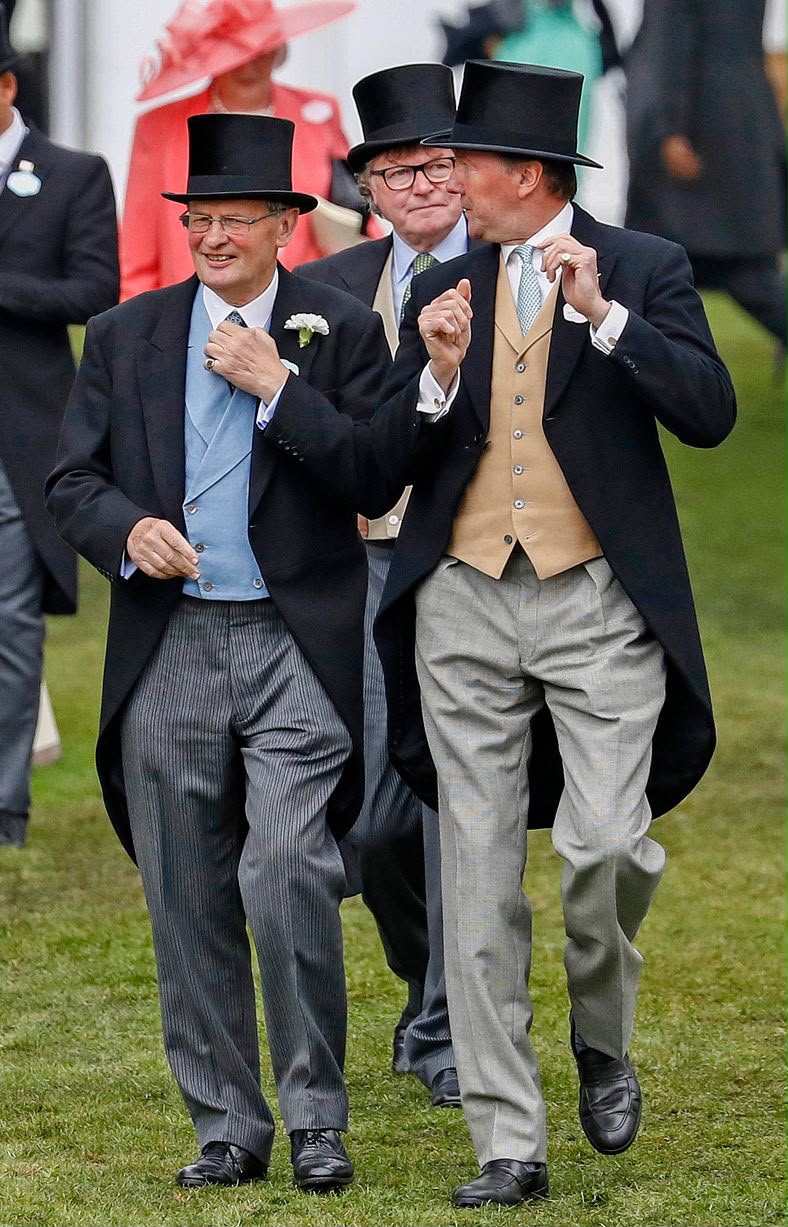
Let us be clear about something before I open the case for the prosecution. There is nothing inherently wrong with dressing for these occasions. Morning dress and top hat, club tie and Panama, the striped rowing blazer carry legitimacy born of tradition — that ineffable value that also imbues the Green of Augusta or the Tartan of Colonial. If, for instance, one is fortunate enough to gain entry to the Royal Enclosure at Ascot, one dresses appropriately. And one does so without irony, because the occasion has earned that formality and so, by extension, have you. This is not costume. This is uniform, and uniform worn in its correct context is one of the most elegant things a man can do.
Exhibit Two, Mi'lud: the college tie. I own and wear the three of my Cambridge college — stripes for town, crested for country, summer for garden parties — earned in the straightforward way that such things are earned, by being there. The Cambridge college tie, or the tie of a Harvard or a Princeton, is a signal. It says something specific and verifiable about the person wearing it. It is, in the right context, entirely appropriate.
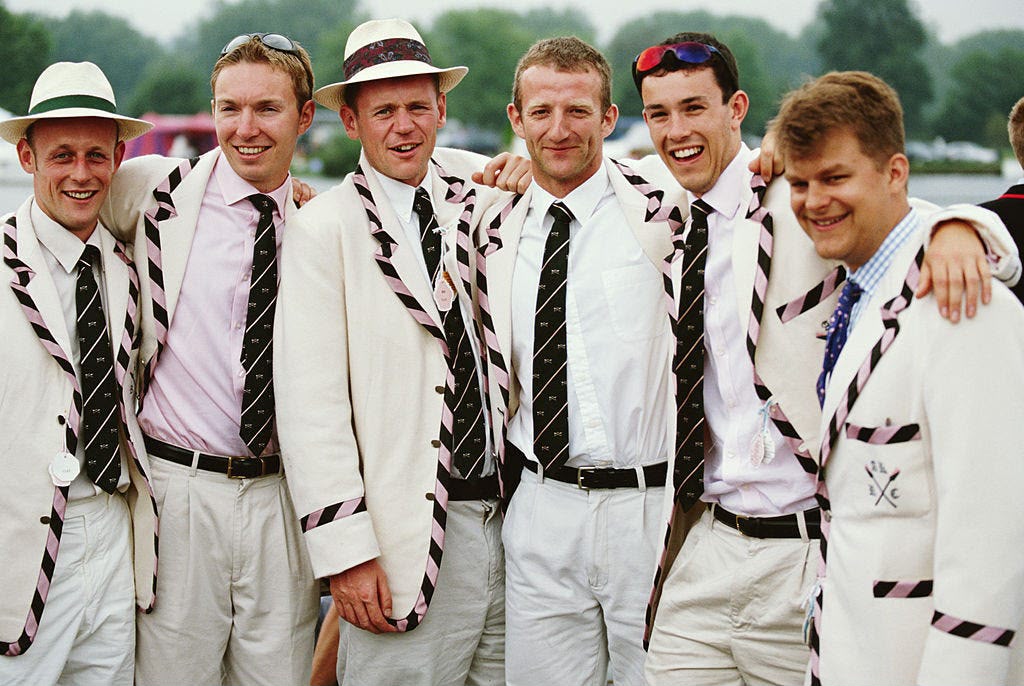
The club blazer of a man who belongs to the club. The rowing blazer of a man who rows, or who rowed, worn at the regatta. The MCC tie at Lord's, worn by a member. These are legitimate. They carry meaning because they carry history. The garment and the man are in honest relationship with each other.
The test is simple: does this garment signal something real, or is it filling a vacuum?
On the Fraudulent Signal
Cast your minds back to last month's article. I have since seen a photograph of my main protagonist adorned in the red and blue of Penn. Legitimate or costume, a signal or just a look? The college tie worn by a man who did not attend the college is not a signal. It is a lie told in silk. Before you accuse me of snobbery — it is a matter of basic honesty. The tie (or for that matter, the sweatshirt) exists to communicate something specific. Wearing it without the substance behind it is the sartorial equivalent of claiming a qualification you don't have. In some professions this would be actionable. In menswear it merely marks you out to those who know, which is always more people than you think.
"A lie told in silk."
The rowing blazer worn at Henley by a man who has never been near a boat is a prop. It is fancy dress. The blazer itself is often a magnificent object — the colours of real clubs, real history, real competition on real rivers. Stripped of that context, it becomes a costume for a character the wearer has invented for the afternoon. This is not inherently a crime. There is no law against it. But buyer beware: to do so should be with full knowledge. It rarely is.
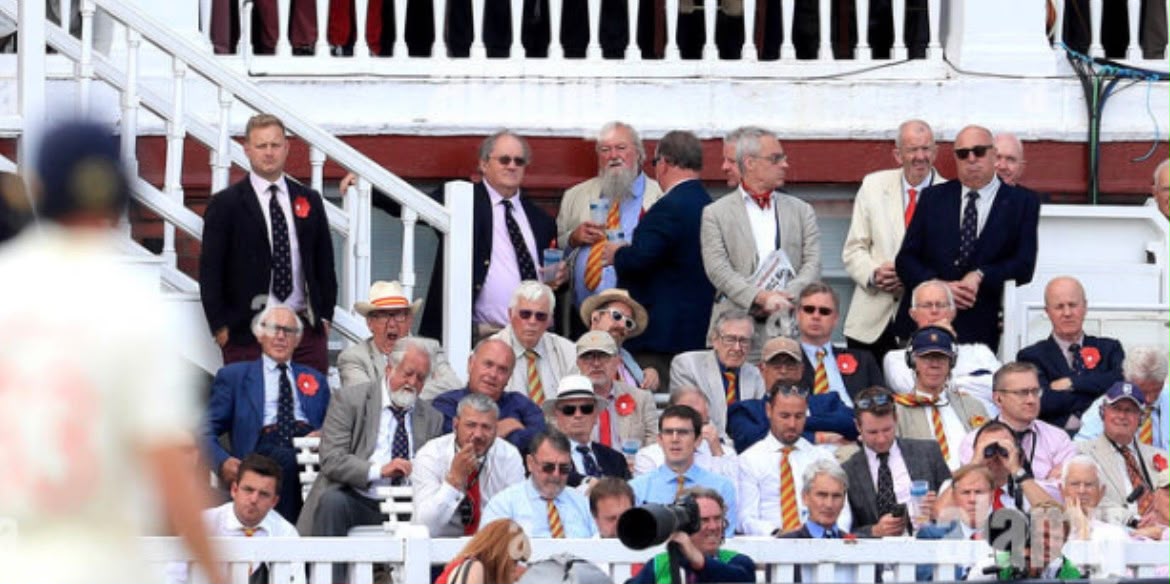
The MCC tie outside Lord's, on a non-member, worn because it looks distinguished — this is the most optimistic form of social fraud. The MCC has approximately eighteen thousand members and a waiting list that would test the patience of a saint (none of whom, as far as I am aware, have ever lunched in the Long Room). The tie is not decorative. It is documentary.
On the Bow Tie
The bow tie. One of modern menswear's most divisive oddities. The bow tie requires its own section because it occupies a special category: the garment that was once a legitimate professional signal and has since become an affectation, now so associated with affectation that even its legitimate uses carry a faint whiff of costume.
In that dim and distant past, say 1980, the architect who wore a bow tie was communicating something within a professional context that understood the signal. The creative professions had their own dress codes, their own eccentricities, their own ways of marking themselves as distinct from the suits. The bow tie said: I am a certain kind of person, working in a particular professional field, and this is how we dress. The signal was real.
The context has dissolved. The bow tie in 2026 says: I have decided to have a signature. This is not the same thing. A signature is earned by having something to sign. The bow tie as personality substitute is the clearest example of the broader problem — the garment deployed not to signal membership of something real, but to perform a version of oneself that the wearer finds more interesting than the original.
A black bow tie, in Repp silk, worn with dinner dress — this remains entirely correct and should not be caught in the crossfire. It is a uniform, worn in context. Occasions for its use may have diminished, which to my mind is all the more reason to laud its continued impact.
On Coloured Braces and Novelty Waistcoats
No.
I suppose this requires slightly more than one word, so: the coloured suspender and the novelty waistcoat exist at the precise intersection of the desire to be noticed and the inability to achieve that through any more demanding means. They are purchased in the belief that personality can be outsourced to haberdashery. It cannot. A man with genuine character does not need his waistcoat to do the work for him.
The rowing blazer is possibly the perfect example of the uniform earned by effort. The best examples, as with most well made clothes, are often the shabbiest — colours faded by sunlight, or inadvertent use as a dog blanket, cuffs frayed or repaired. Now that is a signal.
In Defence of Genuine Eccentricity
The English summer season is one of the last places in the world where a man may dress with real ceremony. This is worth defending. The morning coat is not ridiculous. The top hat is not absurd. The egg-and-bacon — the red and yellow tie of the MCC member in the Lord's pavilion — is one of the most quietly authoritative pieces of neckwear in existence. Worn in its context, by a man who understands what he is doing and why, these are among the most distinguished things available to a man who wishes to dress well.
What undermines them — what undermines the whole enterprise — is the man beside him in the lime green novelty waistcoat and the comedy braces and the tie of a club he has never heard of and the blazer of a boat he has never rowed, performing a version of English summer that he has assembled from images rather than experience.
Eccentricity is real. It grows from character, from history, from a genuine relationship between the man and the things he wears. It cannot be purchased.
"The signal, to mean anything, must be earned. The noise is just noise."
A closing note — possibly incurring the wrath of the New York Fashion Geek himself — Spike Lee achieves all of the above at the Garden — eccentricity, tradition, colour — in short, a uniform to be celebrated. Go Knicks!
Nicholas Whittle
Contributing editor. Based in Central Java.
Writes on menswear, watches, and the correct way to make a Martini.